
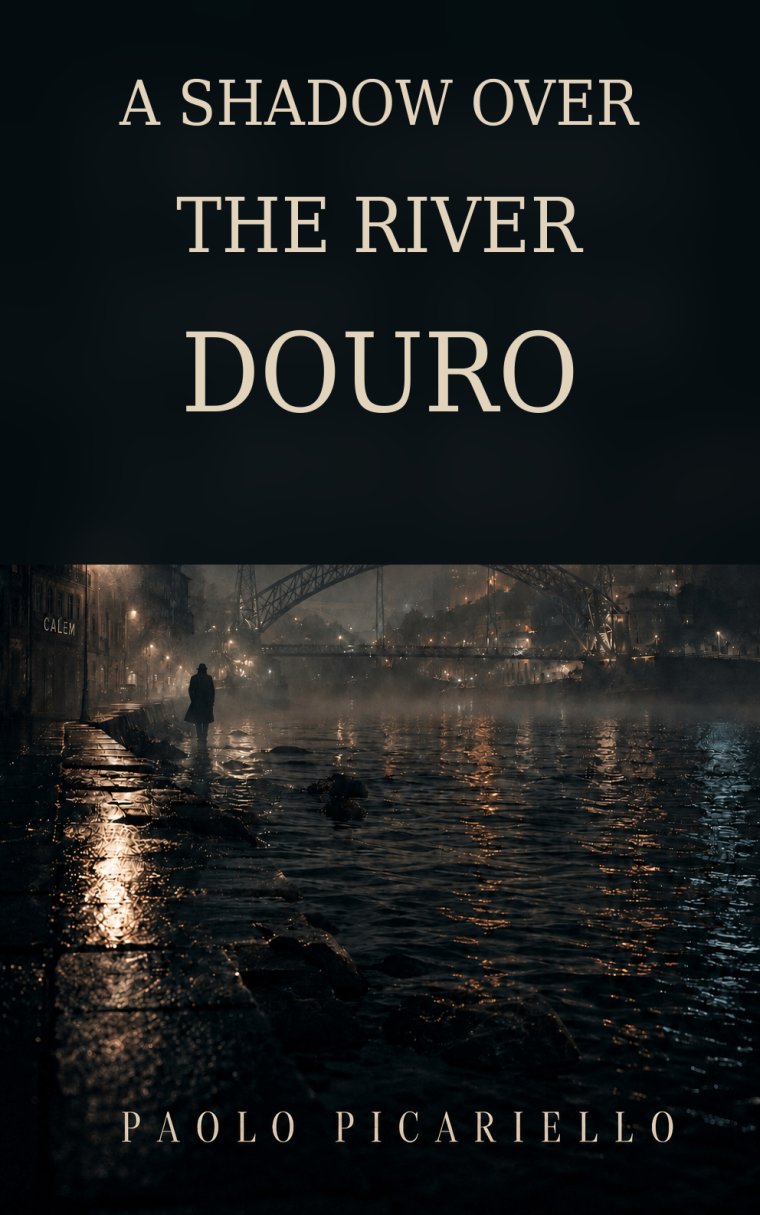
A Shadow Over the River Douro
Page and synopsis also available in: Italiano Português Español
Reading preview available in: Italiano, Português, English.
Synopsis
A short noir novel set between Genoa and Greater Porto, along the Douro river.
Preview
by Paolo Picariello Porto, August–December 1992 AUTHOR'S NOTE This novel is set in Greater Porto in 1992, in a neighbourhood of fishermen, prostitutes, thieves and decent people called Afurada. The events, characters and criminal organisations depicted are works of fiction. Any resemblance to real people is entirely coincidental. Ten really existed.
PROLOGUE GENOA. A SUNDAY IN NOVEMBER 1988. The tarmac was warm against his cheek. That was his first thought — not the pain, not the sound, not the understanding of what had happened. Only the warmth of the tarmac beneath his cheek, in November, as though the square had trapped October's sun inside the stone and refused to surrender it. Then the sky. Seen flat on his back, Piazza De Ferrari was another square — the fountain at its centre like a circle of metal that never stopped, the buildings looming on four sides like the walls of a well too wide, a grey November sky turning slowly to the right; or perhaps he was the one turning. It was hard to tell which of them was moving. The sound came afterwards. First the warmth and the sky, then the sound: a continuous, piercing whistle, like something inside his ear trying to drown out everything else. Then the voices. Someone calling his name from under water. Then the pain. He tried to get up. His legs did not respond as they should. It was not paralysis — he could feel them, which was already something. The signal set off, but something interrupted it along the way. ‘Ricci. Ricci, keep still. Don't move.’ Marchetti's voice. His deputy. A voice he had known for years — how many? Seven, eight? — and which now seemed to come from very far away, even though Marchetti was half a metre from him, kneeling on the tarmac, his hands doing something behind Paolo's back. ‘Dux.’ He said the name without thinking. It was his first whole word: not Marchetti's name, not a plea for help. The dog's name. ‘Is Dux all right?’ Marchetti did not answer at once. That two-second pause held everything. ‘Keep still, Paolo. Keep still.’ He said nothing more. There was no need. Dux was not all right. He closed his eyes. The tarmac was still warm against his cheek. The fountain made its circular, ceaseless sound, which never stopped, not even now, not even with the square full of sirens and voices and everything that happens when something serious goes wrong in a public place. He thought about what had just happened. Not the pain, not his legs — how it had happened. A planned operation. Route changed at the last moment — a decision made that morning, shared with no more than three people. A window of only a few minutes between the change and the execution. Yet someone had known. Someone had known the exact route, the exact moment. Someone on the inside. It was not yet a name. It was a shape — the outline of someone he knew well enough, someone close enough, someone who had found enough reasons to sell what he knew. Rex had died two years earlier, in the other compromised operation Paolo had put down to bad luck. The collar had remained in a drawer, because some objects become difficult to throw away after they have touched something we loved. Now, with the Genoa sky above him and the sirens drawing nearer, he understood that perhaps it had not been bad luck. Now he was beginning to understand that the two things might be connected. There was still no name. Only the shape of someone — close, trusted, bought — moving at the edges of what he was able to think. The ambulance arrived. Hands turning him over, a stretcher, the sky becoming vertical again instead of horizontal. Someone talked to him without stopping. Paolo answered in monosyllables, his attention somewhere else. Somewhere the shape of a dog that no longer existed still remained. And a man was not where he should have been. ✦✦✦
PART ONE A SHADOW OVER THE RIVER DOURO Greater Porto — August / September 1992 I AFURADA — 14 AUGUST 1992 Miguel came in at twenty past ten. Paolo recognised him by his posture before he even saw his face: the rigid shoulders, the gait of someone who keeps moving only because stopping would be worse. He rose from the counter. ‘Miguel.’ The other man stopped halfway across the bar. He was clutching a preserving jar between his hands. ‘Fourth day,’ he said. ‘The police say they still have nothing else.’ Paolo had known Sofia since she used to run along the quay with her laces undone. He also knew the face of a father who could no longer call what he was doing waiting. He pointed at the jar. ‘Is that the pillowcase?’ Miguel nodded. ‘Sonia took it off the pillow as you told me. She put a clean bag over her hand, without touching the fabric, then sealed it in here.’ Paolo checked the lid. Glass retained a cleaner scent than the T-shirt Miguel had taken to the police, which had already passed through too many hands. It did not make the dog infallible; it merely reduced one of the many reasons he might get it wrong. ‘Who saw her last?’ ‘Fernanda. At Fonte dos Leões, the night of the festival. She says it was twenty to one. Sofia stayed there to wait for someone.’ ‘Do the police know?’ ‘Since yesterday.’ Paolo picked up the telephone and called Fernando Vieira. He told him about the place, the time and the jar. He did not ask for an authorisation Fernando could not give him; he asked for an officer to keep the starting point clear and record every movement. When he hung up, Ten had already risen from his bed. He came over to the table, sniffed the air and looked at Paolo. ‘Not here,’ Paolo told him. ‘We begin at the last place we know she was.’ He took the harness, the long line and a bottle of water. Maria came out from behind the counter and straightened his collar with a quick gesture. ‘Don't promise Miguel what you don't know.’ ‘I don't.’ Miguel followed them to the door. ‘Will you find her?’ Paolo looked at the jar, then at the dog. Four days of heat, wind, traffic and thousands of footsteps separated Sofia from that square. ‘We're looking for a direction,’ he said. ‘If Ten can't find it, he'll tell us. That is useful too.’ They went out into the white glare of August. The Douro shone at the end of the street, the nets were rolled on the quays and a gull cried above the rooftops.
Ten jumped into the car without being called.
II THE TRAIL They reached Fonte dos Leões shortly after midday. Fernando had kept the onlookers back with two barriers and a plain-clothes officer. Fernanda indicated the exact spot: the rim of the fountain facing Rua das Carmelitas. That was where she had left Sofia four nights earlier, sitting with her bag on her knees. ‘Was she waiting for François?’ Paolo asked. ‘She didn't say. She only said she was meeting someone.’ Paolo did not question her further. He looked at the paving stones, the short shadows, the continuous flow of people. It was a terrible starting point: open, heavily crossed, washed every morning. But it was a known point, not a hypothesis. He buckled Ten into his tracking harness and attached an eight-metre long line. He opened the jar without removing the pillowcase and held it out to the dog. Ten inhaled twice, turned his muzzle away, then returned to the scent. Paolo closed the container at once. ‘Find.’ He did not indicate a direction. He stepped back and let Ten build his own picture. The dog traced a semicircle around the fountain. On his first exit he took Rua do Carmo for a few metres, slowed, then came back. On the second he checked the edge of a flower bed and returned with the line slack. On the third his body changed: head lower, shoulders forward, steady tension on the line. Paolo followed without shortening it. That did not prove Sofia had gone that way; it was behaviour consistent with the scent being sought. The distinction would be enormous in a report. It had to remain so in his own mind as well. Ten went down towards Rua de Ceuta. At times he worked along the kerb and at others two or three metres off line, where currents between the buildings had moved the scent. At each crossing he widened his search, tested an exit, discarded it and continued. Paolo read the tension in the long line, not the nose. The nose might be high or low; the decision lay in the whole body. After twenty minutes they stopped in the shade. Paolo gave him a little water and waited for his breathing to settle. The heat mattered more than the handler's pride. They set off again. The trail led them to the ramp of a private car park. The attendant wanted to talk, but Fernando made him wait. Ten went down to the lower level, crossed two rows of cars and slowed in front of a bay beside a pillar. He made two small circles, checked the pedestrian passage, then returned to the bay. Then the tension vanished. Paolo gave him the full length of the line. Ten tried the vehicle exit, came back, searched along the wall and returned once more to the pillar. No clear continuation. ‘Outside,’ Paolo said. He let him rest for five minutes, then repeated the check from the opposite corridor. The result was the same: arrival at the bay, a brief, scattered search, no pedestrian trail leading out. Paolo took off his cap and looked at Fernando. ‘He loses the trail here. She may have got into a vehicle. There may also be too much contamination for him to continue. I can't tell you which.’ The attendant remembered a dark-green van entering after midnight and leaving less than ten minutes later. He remembered two men and a girl on the front seat; not the whole registration, only the final letters. Fernando had the bay isolated. There was a recent oil stain and a tyre mark, things the laboratory could compare and the dog could not. Ten lay down on the cool concrete, tongue out. ‘Good boy,’ Paolo said. Not because he had found Sofia. He had marked out part of her last known route and had known when to stop where the information ended. It was the least spectacular part of the work and the part Paolo most trusted himself to bring to Fernando. ✦✦✦ There had been six puppies in André's enclosure three years earlier. One bit at shoelaces, one barked at everything, one tried to climb the fence. Ten watched. He had sat two metres from Paolo and studied him with the disproportionate seriousness he would retain as an adult. Then he rose, crossed the distance and placed himself at Paolo's side. ‘What's his name?’ Paolo had asked. ‘He hasn't got one yet.’ ‘Ten.’ There had been no reason. Only the right sound.
Want to keep reading? Download the full book below.
Reader comments
No comments on this work yet. Yours could be the first.