
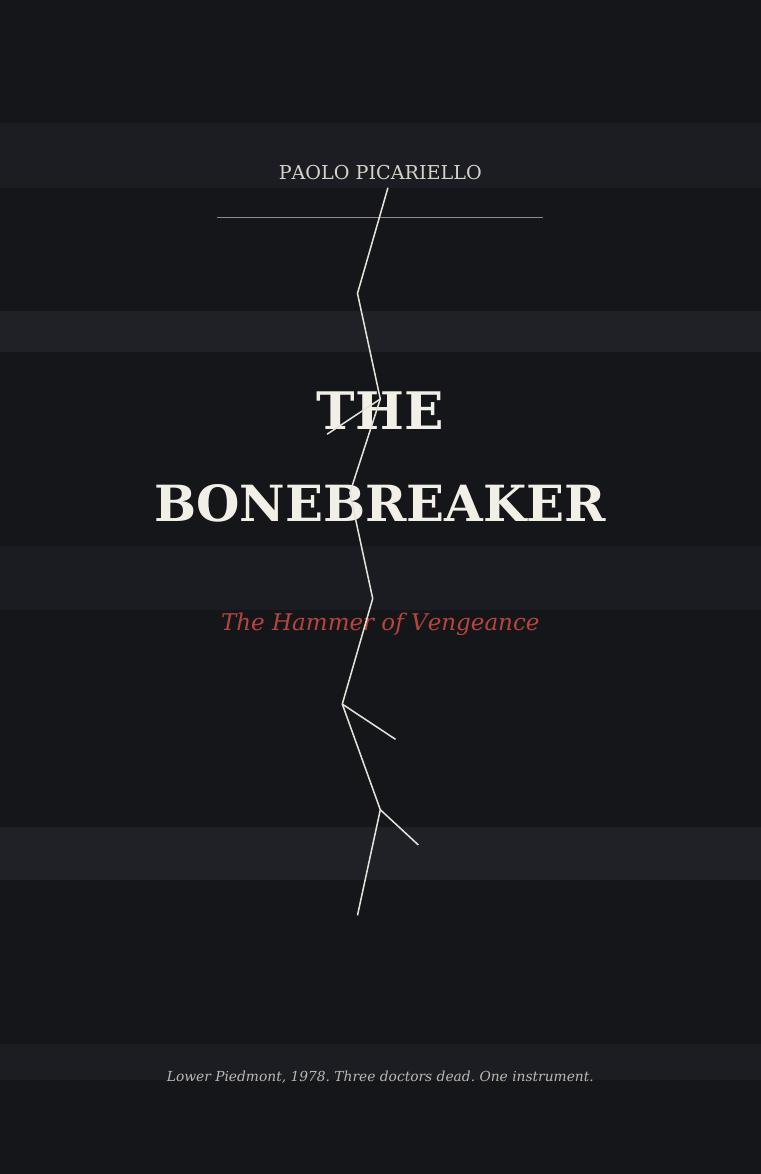
The Bonebreaker
Page and synopsis also available in: Italiano Português Español
Reading preview available in: Italiano, Português, English.
Synopsis
In Lower Piedmont, 1978, Inspector Ugo De Salvo investigates a string of murders committed with an orthopedic hammer. The victims lead to a clandestine medical network and a revenge that had waited years.
Preview
The Hammer of Vengeance Lower Piedmont, 1978. Three doctors dead. One instrument.
The Hammer of Vengeance A noir novel Original title: Lo Spaccaossa. Il martello della vendetta Translated from the Italian (revised and corrected edition, 2026) © 2026 Paolo Picariello All rights reserved. This is a work of fiction. Characters, institutions, companies and events are the author's invention; any resemblance to real persons or facts is unintended.
The Silence Beneath the Operating Table The blood, in the sterile half-light of the operating theatre, had a metallic smell. The smell of the end. The body of Dr Arturo Teixeira lay on its back, the gown open like an emptied straitjacket, the eyes fixed on the neon flickering above table number twelve. He still had his surgical mask on, but the face was ruined. The brow ridge split, the skull caved in by something heavy. Beside the table, half hidden under a white sheet, was an orthopaedic hammer. Stained. The stains never lied. Inspector Ugo De Salvo went in first. Tall, broad-shouldered, the face of a repentant boxer and an overcoat that seemed to carry the weight of the whole station on its own. He was fifty-two and wore every year of it, except in the early morning, when the dark was still thick enough to hide the lines. Behind him, Officer Andrea Marino took notes without looking up. Thirty-one, precise to the point of stubbornness, too well dressed for the trade. De Salvo respected him: faced with a scene like this, Marino could still observe before he judged. 'Teixeira. Portuguese. Specialist in reconstructive orthopaedics. He'd worked here five years,' Marino said, leafing through the medical file. 'No sign of forced entry. No alarm. The door was locked from the inside.' 'So the killer knew how to get in. And how not to be noticed,' De Salvo muttered. He bent over the hammer without touching it. On the handle, among the stains, a milky trace remained: surgical-glove talc, perhaps. De Salvo pointed it out to the forensics photographer, then straightened up. The scene was surgical. Nothing was out of place, except the death. 'Who found him?' the inspector asked.
PAOLO PICARIELLO · THE BONEBREAKER 'A nurse on the night shift. She was expecting him for the six o'clock operation. She says he was always punctual. Precise.' De Salvo nodded. Then he turned towards the flickering neon. 'Have that switched off. It gets on my nerves.' They went out into the corridor. A smell of disinfectant and burnt coffee. Outside, the Novi fog wrapped the dawn like gauze. De Salvo lit a cigarette without a word. The first of the day, always the most necessary. 'What do you think, chief?' 'I think whoever did this knew the theatre and knew where to strike. The rest comes later.' Marino looked at him. 'You think they wanted to leave a message?' The inspector blew the smoke out through his nose. He studied the empty corridor, the neon lights stuttering, the sign on the wall: ORTHOPAEDICS DEPARTMENT - NO UNAUTHORISED ACCESS. 'I don't know yet. First we find out who Teixeira was when nobody was watching.' Marino opened his mouth to answer, but De Salvo was already moving towards the exit. The overcoat vanished into the shadow of the corridor like an animal returning to its den.
The Morning After Novi Ligure at six in the morning smelt of baked bread and diesel. The bakeries opened while it was still dark: a yellow light seeped under the shutters, and the smell of flour mixed with the fog made something ambiguous, as if the world had not yet decided whether it was day or night. De Salvo walked along the avenue that ran beside the hospital. He hadn't gone home. He had slept two hours in the only armchair in the men's changing room at the station, overcoat on, shoes still on his feet. Sissi would not forgive him, but Sissi understood. The Teixeira case had him pinned to something he couldn't yet name. Brutality he had seen before. What troubled him was the order of the theatre: no struggle, nothing knocked over, a weapon taken from the ward and left beside the body. Whoever had killed had moved without haste. He stopped in front of a closed news kiosk. In the window, the morning papers were on display behind the glass: the front page of the Corriere di Alessandria gave the discovery of Teixeira's body four lines at the bottom left. No photo, no headline. The case of a doctor dead in a hospital seemed, at six in the morning, less urgent than the council elections in Casale Monferrato. 'Nobody knows yet,' he said under his breath. For the moment it was just a doctor murdered in an operating theatre. De Salvo distrusted cases that seemed to tell themselves. De Salvo bought a coffee at the corner bar and drank it standing at the counter. The barman - a man in his fifties with grey hair and the hands of someone who has poured a hundred thousand coffees - said nothing. In certain Piedmont bars, silence is a service included in the price. On his way back to the station, De Salvo passed the hospital's orthopaedics department. The red-and-white PAOLO PICARIELLO · THE BONEBREAKER tape was still there. A passing nurse looked at him, then lowered her eyes. Perhaps she knew something. She had lowered her eyes too quickly. He stopped. 'Excuse me.' She turned. Forty, short hair, a folder pressed to her chest. 'Did you work with Teixeira?' 'Sometimes.' 'Is there something you wanted to tell me yesterday and didn't?' A silence. Then: 'I don't want to lose my job.' 'That's not a promise I can make,' De Salvo said. 'But I can promise you that if you don't tell me, you'll tell someone else. And that someone else might not understand.' She lowered her eyes again. Then, quietly: 'Three months ago, Teixeira found a discrepancy in the materials registers. Batches were missing. He filed an internal complaint. The medical director called him in and... after that meeting, Teixeira never mentioned it again.' 'Was he afraid?' 'He didn't seem it. He seemed... resolved. As if he'd decided something.' 'Thank you,' De Salvo said. She walked away quickly, head down. De Salvo watched her disappear along the corridor. Then he took out his notebook and wrote: Medical director - Santa Caterina. And underneath: Teixeira knew. He had decided not to stop. The sun was still low and pale, filtered through the fog as through a sheet of greaseproof paper. De Salvo slipped the notebook into his pocket and set off for the station. There was still a great deal to do before he could go home to Sissi.
Room 4 Room 4 stood at the end of the hospital's east corridor, between the plaster room and the radiology lab. A no-man's corner, where the yellowed walls and the smell of ammonia seemed to hold on to secrets. Inside, the bed was empty. The mattress, stained, still held the imprint of the body that had occupied it until three hours before. That was where Teixeira slept when he wasn't on shift. The nurse who had found him, Carla Bassi, forty-three, hollow-eyed, a smoker's hands, had been staring at a point on the floor for ten minutes. She didn't speak, but she trembled slightly, as if someone had left her out in the cold too long. 'Did you realise straight away that something was wrong?' De Salvo asked. She nodded, without looking up. 'Teixeira always arrived at five forty-five. Never late. Macchiato, two sugars, clean gown. This morning, nothing. I knocked. Nothing. I searched the ward, and I found him there... with...' She stopped. Marino offered her a glass of water, which she refused with the smallest movement of her hand. 'Who did he have problems with?' Marino asked. 'Everyone,' she answered, without thinking. 'He was good, but sour. And he knew too much. He said strange things were going round - expired materials, phantom suppliers. But he didn't trust anyone.' De Salvo turned towards the window. The rain was falling fine and stubborn, as if it were washing Piedmont away piece by piece. 'Who handles purchasing in this department?' he asked. 'Dr Antonelli. But he's on leave. They said he was in Rome for a conference.' Marino raised an eyebrow. De Salvo noted the name: Sandro Antonelli. Another line began there.
PAOLO PICARIELLO · THE BONEBREAKER Before leaving, the inspector cast a last glance around the room: an overflowing ashtray, a gown hanging crooked, and an X-ray forgotten on the desk. A reconstructed knee, with a screw too long. Almost like a warning. In the corridor, Marino closed his notebook. 'There's something here that doesn't add up.' 'It all adds up for me,' De Salvo replied, lighting another cigarette. 'Teixeira had started digging. And somebody decided to cover him with earth. With a hammer.'
Predosa, Home, Night He walked home, though his car was parked beneath the hospital. He needed road. He needed fog. Predosa at night is a village that seems to withdraw into itself. The bar lights off, the front doors shut, the sound of your own footsteps ringing on the cobbles like a question without an answer. De Salvo had known that sound for years. Sissi was waiting for him on the windowsill, as always. The Siamese cat had the habit of sitting exactly in the centre, upright and motionless, like an Egyptian statue passing judgement on her master's return. De Salvo opened the door, and she came down unhurried, without a miaow, and went straight to the empty bowl. 'You too,' De Salvo said. He opened her a tin of sardines - the only thing left. Sissi sniffed it, ignored it with Olympian elegance, and returned to the armchair. De Salvo opened the bottle of Dolcetto d'Acqui he kept on the kitchen windowsill. It had been half full for three days. He put on a record: Howlin' Wolf, Smokestack Lightning. The turntable crackled through the first seconds, then the rasping voice filled the room like smoke. He sat down at the table. In front of him, the Teixeira file. A few pages. A life reduced to paper. Arturo Teixeira, fifty-six, arrived from Portugal in 1954, specialised in orthopaedics in Turin in 1960. Widower. No children. A rented flat in Novi. Nothing out of place. De Salvo thought that lives reduced to a file always had this in common: they looked normal. His own, probably, looked normal too. Inspector. Divorced. No children. A flat too big for him in Predosa. It hadn't always been like that.
Want to keep reading? Download the full book below.
Reader comments
No comments on this work yet. Yours could be the first.